
1. LETTERS OF THE TAFI ALPHABET
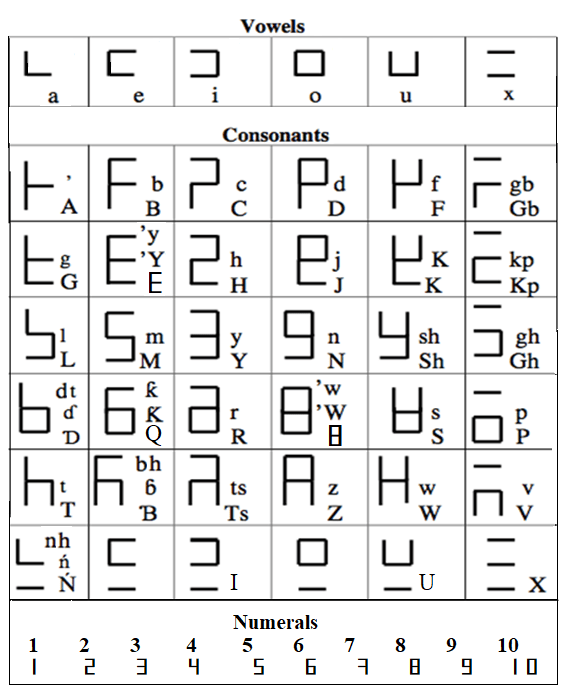
Letters of the All Nigeria Tafi Alphabet (ANTA) are built from 6 basic signs called digits, which stand as the primary vowels a, e, i, o, u and extra x . The 6 digits are joined together in twos, bottom to top, to form 36 consonants, including the numerals ( 1- 9), as shown below. Zero (0) is a combination of two digits – ‘u’ under ‘inverted u’. The six primary vowels and 36 consonants are sufficient for most of the Nigerian languages, including English. Some languages may require additional 2 or 3 symbols, as secondary vowels.
2. FONTS OF LETTERS OF THE TAFI ALPHABET
Tafi TrueType Fonts have been constructed from FontStruct.com, a free online font-building tool, devised and developed for Fontshop International by Bob Meek. The Tafi characters, because of their square shapes, are very amenable to font building using FontStruct. The reader is urged to try his hands on this powerful tool, after learning the shapes of the letters of the Tafi alphabet. He can easily construct the Tafi fonts and install them in his computer.
Square Tafi fonts may be obtained, from these links:
https://www.dropbox.com/sh/a42oz597inwkdy8/AACdbtFV4G90r8lT78z0GJ8ra?dl=0
https://1drv.ms/u/s!Aj7zQGJaYQtxpzyvy_rbKaAya190?e=9R8Akj
(Open the font file and follow the instructions)
3. FONTS OF LETTERS OF THE ENGLISH TAFI ALPHABET AND OTHER SYMBOLS
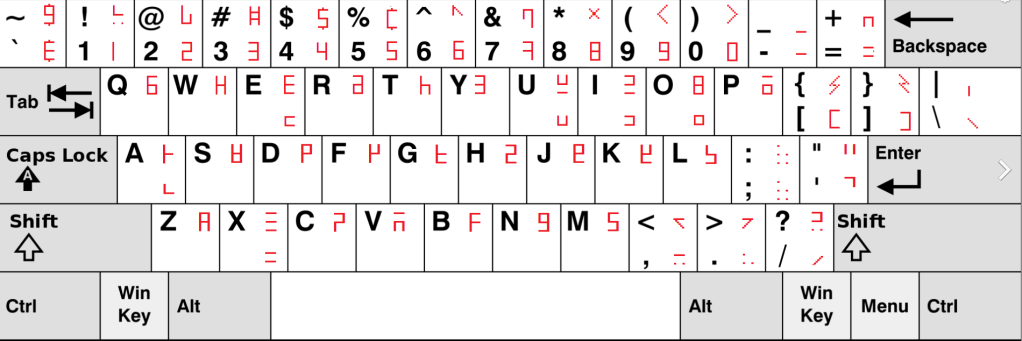
Tafi fonts may be uploaded in a computer to give a QWERTY keyboard as shown in Figure 2 below. The Tafi letters are consonants as capitals, 6 long vowels and the respective 6 short vowels: a, e, i, o, u and x. The numerals, 26 letters of the English alphabet, punctuation marks and other symbols are shown in black and the corresponding Square Tafi Fonts in red.
4. THE UNIVERSAL TAFI ALPHABET
The Universal Tafi Alphabet (UTA) of 100 (not all unique characters), formed by joining 10 digits, two at a time, is presented below, with the tentative Arabic and Latin equivalents. The six primary vowels a, e, i, o, u and x are shown on top. The additional vowels required to transcribe the Nigerian languages properly well in the Arabic script, are indicated for e, o and x. African languages call for more vowels and vowel intonations than the Asian and European languages.
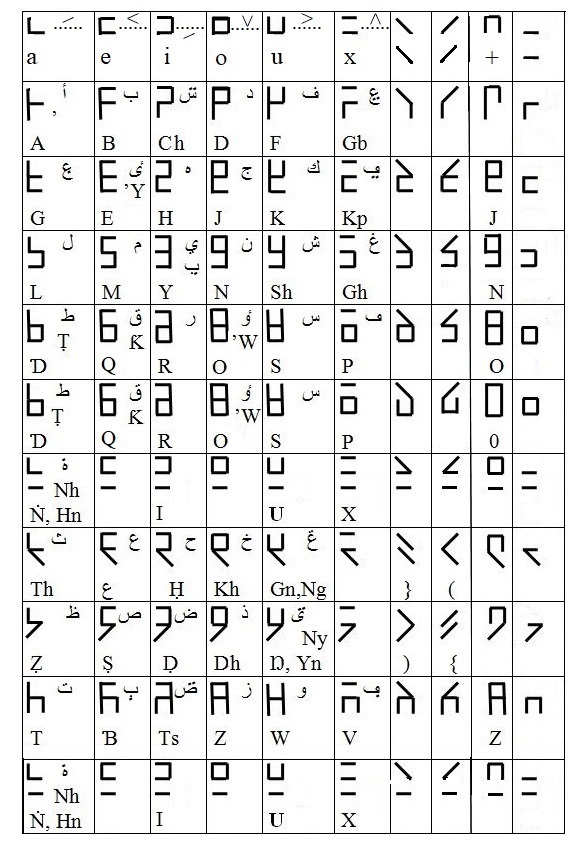
The UTA, shown above, includes the mathematical symbols and the numerals (1 – 9) and 0. There should be sufficient letters, with spare symbols in the last four columns, to cater for all the languages of the world. More work is required here, but the need for an International Tafi Alphabet cannot be overemphasized.
5. TAFI AS AN INTEGRATED SYSTEM OF WRITING
It should be mentioned that Tafi is an integrated system of writing for normal people as well as the challenged members of the community. There is a system of Tafi writing for the blind to ‘read’ by touch, as with Braille or Moon, and another one for the deaf and deaf-mute to communicate through signals, beats or flashes in a code of dots and dashes, as for sign language, touch language, tap language or semaphore.
6. STRUCTURE OF THE WEBSITE
The website is structured in four sections, A, B, C and D:
A. Letters and the fonts, as constructed and presented in this first section.
B. Introduction of the Tafi alphabet and Tafi writing for Hausa, Igbo, Yoruba and English.
C. Development of English Teaching Tafi Alphabet (ETTA) on the basis of the Initial Teaching Alphabet (ITA) used in England. (ETTA is designed to enable learning of English writing and speaking effectively, after a person might have learned Tafi writing in his or her mother tongue)
D. Use of English Keyboard for Tafi writing, to take advantage of an existing and popular Keyboard (loaded with Tafi fonts) without the need for an extended Keyboard for the Nigerian languages.
Please keep in touch. All comments and inquiries will be attended to promptly.
Musa D. Abdullahi. musadab@outlook.com
 musadab